
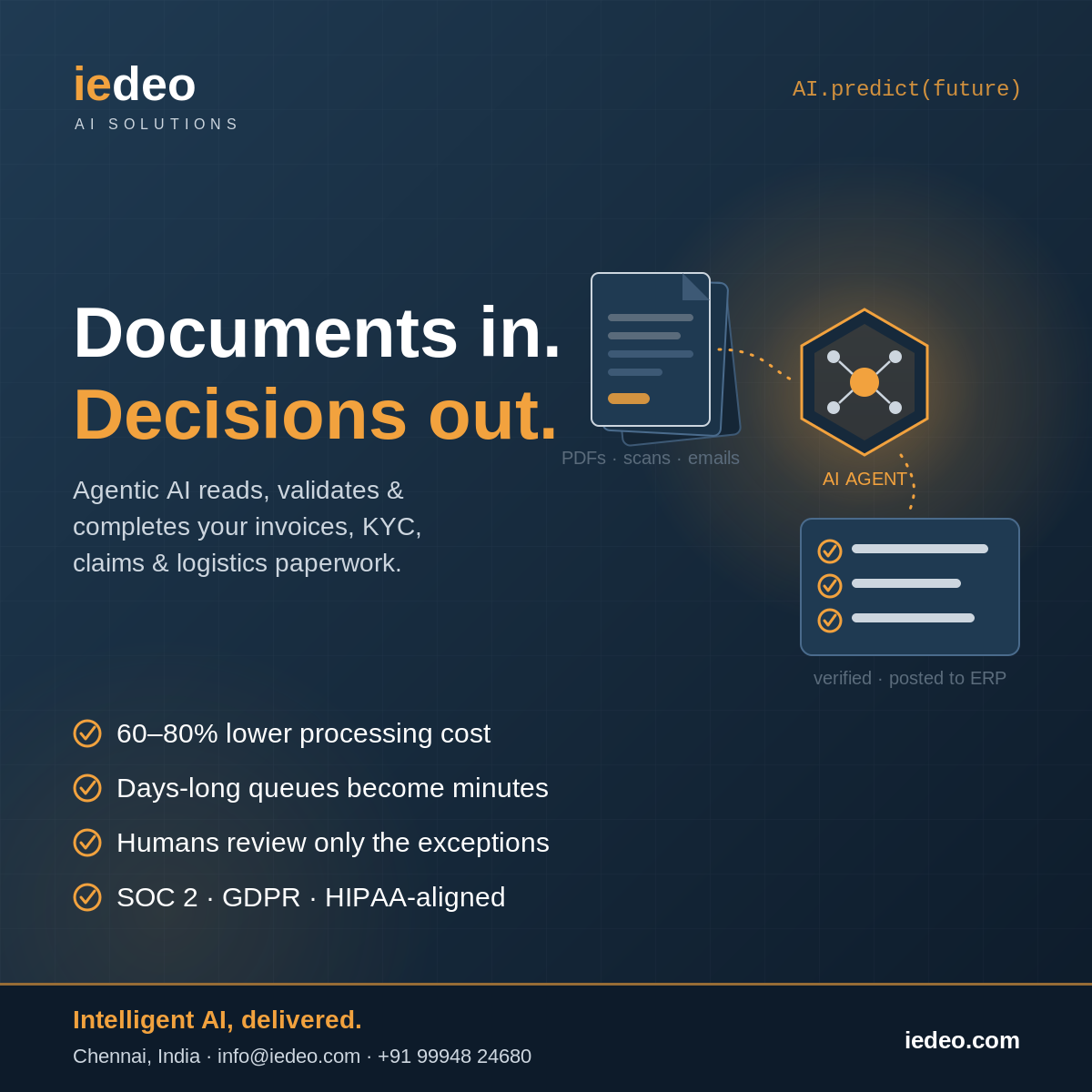
Every enterprise runs on documents: invoices, purchase orders, insurance claims, KYC forms, bills of lading, patient records, loan applications. Yet most of these still move through inboxes, scanners and spreadsheets, with people retyping fields into ERP and core systems. That manual layer is slow, error-prone and expensive — and in 2026 it is also the easiest thing to automate well. AI document processing automation, often called intelligent document processing (IDP), reads any document, extracts the data that matters, validates it and pushes it straight into your systems.
What AI Document Processing Automation Actually Does
Traditional OCR could turn a scan into text, but it could not understand a messy, unseen invoice layout or a handwritten claim form. Modern IDP combines computer vision, large language models and business rules to do four things in one pass: classify the document type, extract structured fields, validate them against your data, and route the result. The big shift in 2026 is from extraction to reasoning — systems no longer just find a date or a total, they can answer questions about the document and explain why a value was chosen. Multimodal models now read text, layout, tables, stamps and handwriting together, which is why mixed-content processing is the fastest-growing part of the document AI market.
High-Value Enterprise Use Cases
The strongest returns come from high-volume, repetitive documents. In banking and finance, IDP automates KYC, loan onboarding and accounts-payable invoice capture. In insurance, it reads claims and supporting evidence so adjusters focus on decisions, not data entry. In healthcare, it structures intake forms and lab reports while keeping audit trails. In logistics, it processes bills of lading and proof-of-delivery at scale, and in retail it reconciles supplier invoices against purchase orders.
Why It Works Now
Three things changed. Models can handle layouts they have never seen, so you no longer build a brittle template per vendor. Self-validation loops let the system check its own output against master data, enabling "zero-touch" processing where most documents reach the ERP with no human involved. And buyers can finally demand proof — production workloads, measurable accuracy and clean integration — rather than slideware.
The ROI Case
The numbers are concrete. IDP typically cuts document processing time by 50% or more and can reduce error rates by over half. Mature, LLM-assisted pipelines reach around 99% accuracy on common document types through automated validation. For Iedeo's enterprise clients, the manual-effort reduction on data entry usually lands in the 60-80% range, which translates directly into faster cycle times and redeployed staff. Analysts project that roughly 70% of organizations will use some form of IDP by 2026, and first-year ROI on automation programs commonly runs from 30% to 200%, driven mostly by labor savings.
How to Roll It Out in 8-14 Weeks
You do not need a two-year transformation. A focused rollout starts with one painful, high-volume document type and a clear success metric — say, straight-through rate on AP invoices. The first weeks go to data readiness: gathering real document samples, assessing quality and mapping the target fields and downstream system. Next comes building the extraction and validation flow, with a human-in-the-loop queue for low-confidence cases so accuracy climbs safely. Then you integrate with the ERP, CRM or core system and run in parallel before cutover. Iedeo builds these production-ready pipelines in 8-14 weeks, multilingual where needed (Tamil, Hindi, English, Arabic) and aligned to SOC 2, GDPR and HIPAA expectations.
Security, Compliance and Trust
Documents are some of the most sensitive data an enterprise holds, so automation has to be built for governance from day one. That means encryption in transit and at rest, role-based access, full audit trails of what was extracted and approved, and the ability to keep data in your region or your own cloud. For regulated workflows in banking, insurance and healthcare, the pipeline should map cleanly to SOC 2, GDPR and HIPAA expectations, and confidence scores should be logged so every automated decision is explainable. Done right, IDP is not a compliance risk — it is a compliance upgrade, because the same paperwork that used to live in unsearchable PDFs becomes structured, traceable and reportable.
Getting Started Without the Risk
The safest path is to prove value on one workflow, measure it honestly, then expand to adjacent document types once the straight-through rate and accuracy hold. Keep humans on the exceptions, not the routine, and instrument everything so the ROI is visible to finance. Watch two metrics above all: straight-through rate (the share of documents needing no human touch) and field-level accuracy. When both stay high on real production volume, you have earned the right to scale. If your teams are still retyping fields from PDFs and scans, that is budget leaking every single day.
Ready to turn your document backlog into clean, validated data? book a free consultation and we will map the highest-ROI workflow to automate first.