
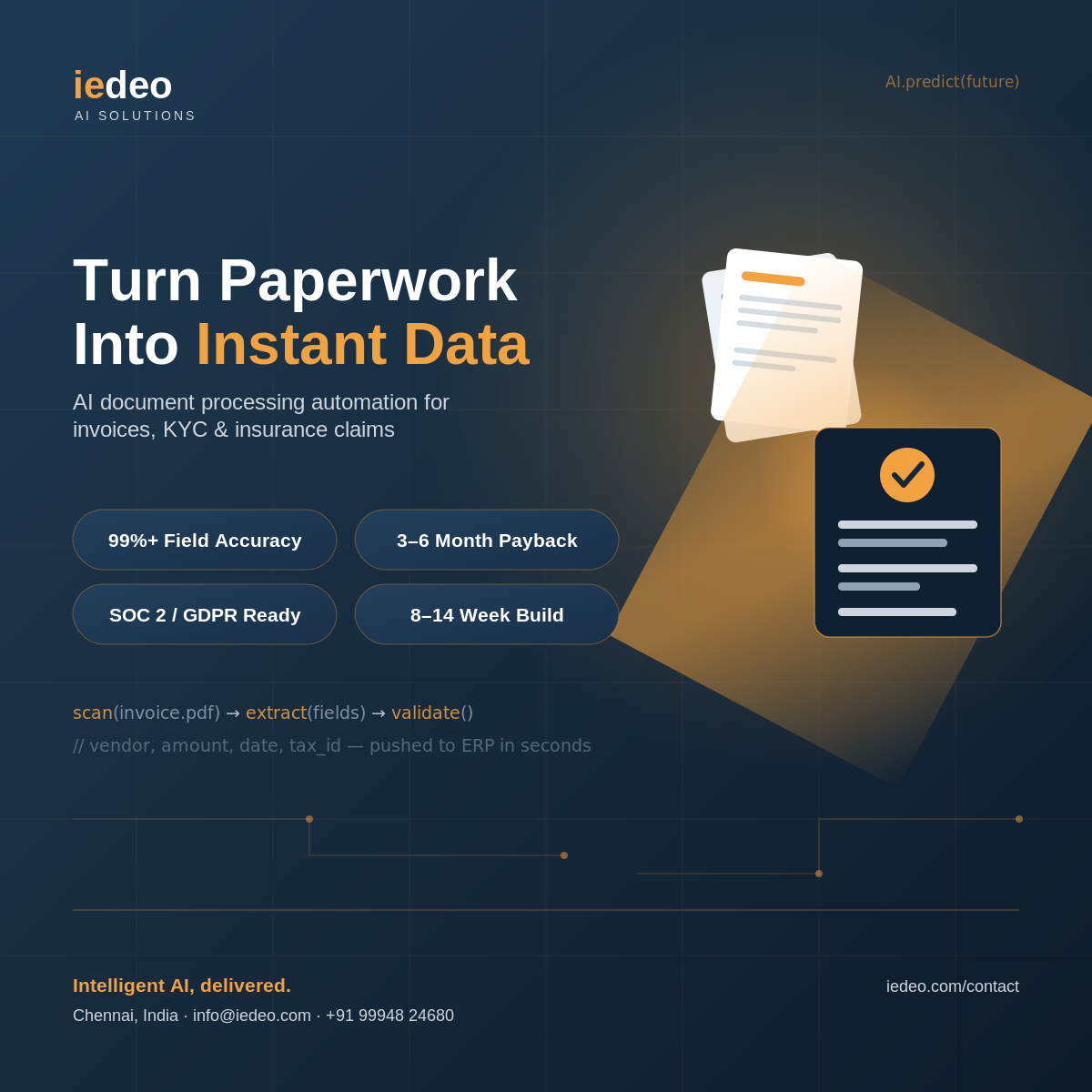
Every enterprise still has a document problem. Invoices arrive as PDFs, scans, and photographed receipts. KYC packets show up as passports, utility bills, and bank statements in half a dozen formats. Insurance claims land with handwritten forms stapled to photos. Someone on your team still opens each one, reads it, and retypes what it says into a system of record. That gap between "we have the data" and "the data is usable" is exactly what AI document processing automation closes, and in 2026 the economics of closing it have become hard to ignore.
What AI document processing automation actually does
Intelligent document processing (IDP) combines optical character recognition, computer vision, and large language models to read unstructured documents, classify them, extract the fields that matter, and validate those fields against business rules before anything touches a downstream system. The shift from older OCR-plus-templates tools to LLM-based extraction is what makes 2026 different: modern IDP handles messy, inconsistent, multi-format documents without a rigid template for every variant, which is the reason most manual queues exist in the first place.
Where it delivers the fastest payback
Accounts payable and invoicing. Manual invoice processing typically runs $10-15 per invoice once you count labor, error correction, and exception handling. Automated processing brings that down to roughly $2-4 per invoice, with well-implemented systems reaching high straight-through-processing rates and 99%+ field-level accuracy. For a mid-size AP team processing thousands of invoices a month, that difference compounds fast.
KYC and customer onboarding. Banks and fintechs use IDP to extract and cross-check data from passports, ID cards, utility bills, and bank statements in seconds instead of the minutes or hours a manual reviewer needs per file. Layering computer vision-based document authenticity checks on top also reduces fraud risk at the same step, rather than as a separate downstream process.
Insurance claims. Property and casualty carriers now route simple, well-documented claims through fully touchless processing, while more complex claims still route to adjusters but arrive pre-extracted and pre-validated. Programs combining IDP with workflow automation commonly report large cuts in end-to-end turnaround time, because the bottleneck was never adjuster judgment — it was data entry ahead of it.
Healthcare records and prior authorization. Patient intake forms, referral letters, lab reports, and insurance correspondence are still overwhelmingly paper or scanned PDF. IDP pipelines built for healthcare need to handle handwriting, non-standard layouts, and strict data-handling requirements simultaneously, which is why compliance posture has to be designed in from day one rather than bolted on later.
Logistics and trade documents. Bills of lading, customs paperwork, and delivery confirmations arrive from dozens of external parties with zero format consistency. Automating extraction here removes one of the most persistent manual bottlenecks in freight and customs clearance.
Why the ROI curve has shifted
A few years ago, document automation projects took 18-24 months to pay back and required heavy customization per document type. Two things changed that. First, LLM-based extraction generalizes across document variants instead of needing a template per layout, which cuts implementation time significantly. Second, the accuracy bar for "good enough to trust without a human check" has risen enough that high-volume, low-complexity documents can go fully touchless. Together, well-run deployments now commonly reach payback in a handful of months rather than years, with first-year returns well above the initial investment once labor reallocation is counted.
None of this means every document type is a candidate for full automation on day one. The realistic path is staged: start with the highest-volume, most standardized document type, prove accuracy and exception-handling in production, then expand into messier categories once the extraction pipeline and human-in-the-loop review process are both mature.
What to check before you buy or build
A few questions separate a system that works from one that becomes a new manual bottleneck:
- Does it handle your actual documents — scanned, handwritten, multilingual, low-resolution — or only clean digital PDFs?
- Is there a clear, auditable human-in-the-loop path for low-confidence extractions, or does everything either pass or silently fail?
- Does the vendor's compliance posture match your data — SOC 2 and GDPR at minimum, HIPAA if health data is involved?
- Can it plug into your existing ERP, core banking, claims, or EHR system without a multi-quarter integration project?
- Does it support the languages your documents actually arrive in? For teams operating across India, the Middle East, and global markets, that often means Tamil, Hindi, Arabic, and English in the same pipeline, not just English.
Getting from pilot to production
Production-ready document automation for a single high-value workflow — AP invoicing, KYC intake, or first-notice-of-loss claims intake — is realistically an 8-14 week build when scoped correctly: a few weeks to profile document variety and define extraction schemas, a core build-and-tune phase against real historical documents, and a validation phase against a held-out sample before go-live. Trying to automate every document type at once, instead of proving one workflow first, is the most common reason these projects stall.
The teams getting the most value out of this in 2026 aren't chasing 100% automation. They're targeting the 70-85% of documents that are genuinely routine, routing those touchless, and keeping skilled staff focused on the exceptions that actually need judgment. That's a more honest, more achievable version of "AI transformation" than most vendors pitch — and it's the version that shows up in the P&L within a quarter, not a year.
If you're weighing where to start, book a free consultation and we'll help you scope the highest-ROI document workflow to automate first.