
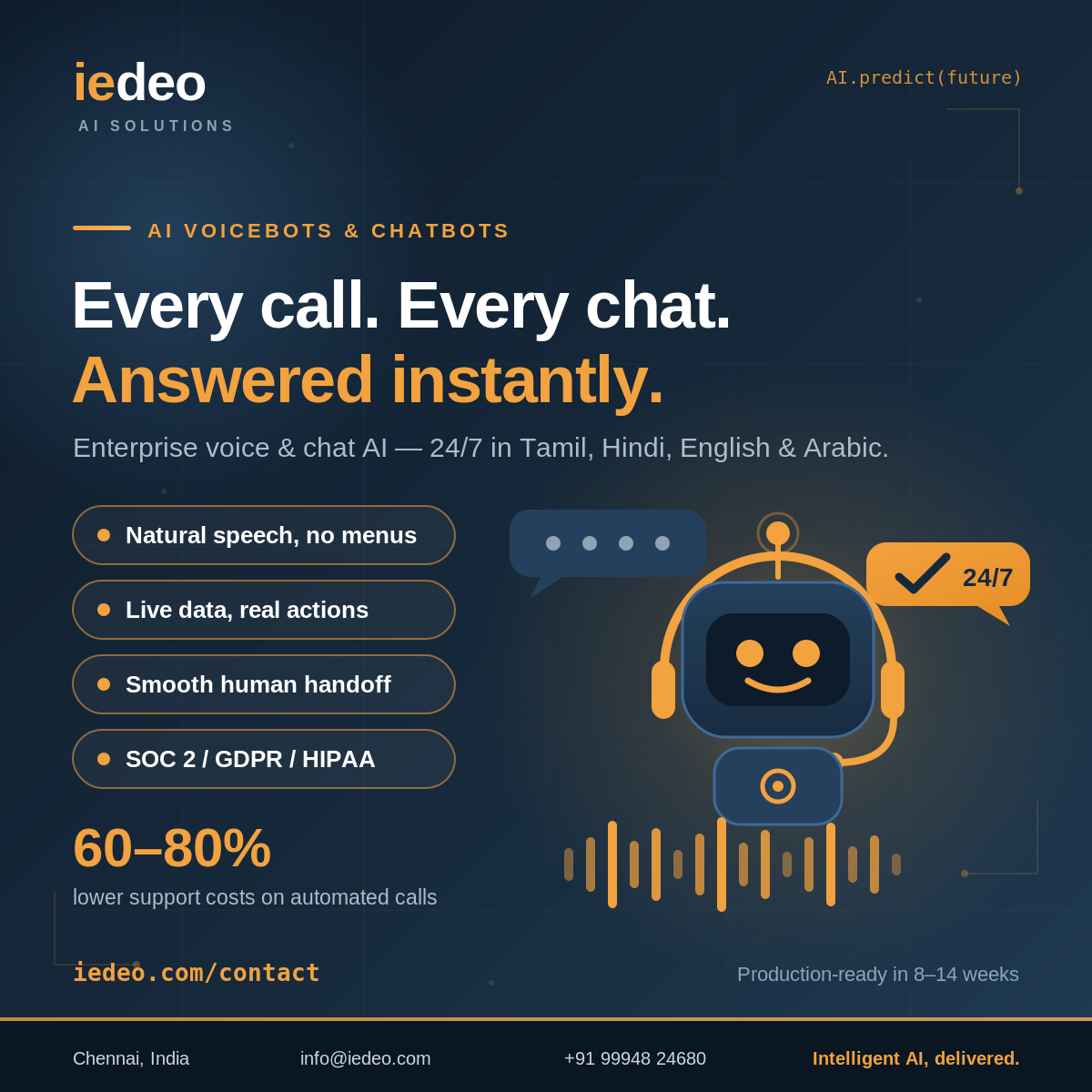
Customers will forgive a lot, but not a phone tree. Long hold times, robotic menus, and "your call is important to us" are still the default experience at most enterprises — even ones that have already shipped chatbots on web and WhatsApp. The irony is that voice is usually the channel customers pick when the issue is urgent or high-value. In 2026, AI voicebots have matured to the point where the phone line can finally be automated properly: natural conversation, real answers, real actions, and a clean handoff to humans when it matters.
The Phone Channel Is Broken — and Customers Notice
Most enterprise call volume is repetitive. Balance enquiries, order status, appointment booking, delivery windows, password resets, payment reminders — the same twenty intents fill the queue every day. Handling them manually means either large support teams or long hold times, and usually both. Traditional IVR was supposed to fix this, but pressing through nested menus only moved the frustration earlier in the call. Customers don't want options; they want answers.
What a Modern AI Voicebot Actually Does
A modern voicebot listens to natural speech, understands intent, and responds conversationally — no menus, no keywords, no scripts to memorise. Crucially, it doesn't just talk: connected to your CRM, ERP, or core systems through secure APIs, it can look up an order, reschedule an appointment, confirm a payment, or update an address during the call. When a conversation goes beyond its scope, it transfers to a human agent with full context, so the customer never repeats themselves.
Voicebot vs IVR: not an upgrade, a replacement. IVR routes calls; a voicebot resolves them. That distinction shows up directly in containment rate — the share of calls completed without a human — which is the metric that drives the economics.
Multilingual Voice AI Is the Real Unlock
For businesses serving India and the Middle East, language coverage decides whether automation works at all. A voicebot that only speaks polished English will frustrate a caller in Chennai or Dubai who switches mid-sentence between languages. Production-grade systems now handle Tamil, Hindi, English, and Arabic — including code-switching — so every customer is served in the language they actually think in. That single capability often widens automation coverage more than any model upgrade.
Where Voicebots Deliver ROI Fastest
Banking and finance teams automate balance and EMI queries, card blocking, and payment reminders — with audit trails compliance teams can verify. Healthcare providers use voicebots for appointment scheduling and pre-visit instructions, keeping front desks free for patients in the room. Retail and e-commerce teams automate order status and returns, the two intents that dominate seasonal spikes. Logistics companies handle delivery confirmations and rescheduling at volumes no call centre could staff. Across these cases, automating high-volume call types typically reduces handling costs by 60–80% compared with scaling agent teams — while answering instantly, around the clock.
What a Production Voicebot Deployment Looks Like
A focused deployment doesn't need a year. The proven path: pick two or three high-volume intents, connect the systems of record, design conversation flows with explicit escalation rules, and test against real call recordings before going live. Security and compliance are built in from day one — SOC 2, GDPR, and HIPAA-aligned controls, consent handling, and PII redaction in transcripts. With that scope discipline, enterprises typically go from kickoff to production in 8–14 weeks, then expand intent coverage iteratively once the containment data shows what callers actually ask.
How to Evaluate a Voicebot Partner
Before signing with any vendor, ask four questions. Can they demonstrate latency low enough for natural conversation, ideally with a live phone demo rather than a recorded clip? Do they integrate with your actual telephony and CRM stack, or only with their own platform? How do they measure and report containment rate, escalation quality, and customer satisfaction after go-live? And who owns the conversation data and models when the engagement ends? A capable partner answers all four plainly — and shows you working deployments in your industry. Teams that evaluate on these fundamentals, rather than demo polish, consistently end up with voicebots that survive contact with real callers.
The Bottom Line
The phone is your most urgent, most human channel — and the one where bad automation does the most damage. Done right, an AI voicebot answers every call instantly, speaks your customers' languages, completes real tasks, and knows when to bring in a person. That's not a futuristic bet; it's buildable on your systems today.
Iedeo designs and ships production voicebots for enterprises across India, the USA, the UK, Europe, and the Middle East. If your support line deserves better than a phone tree, book a free consultation.