
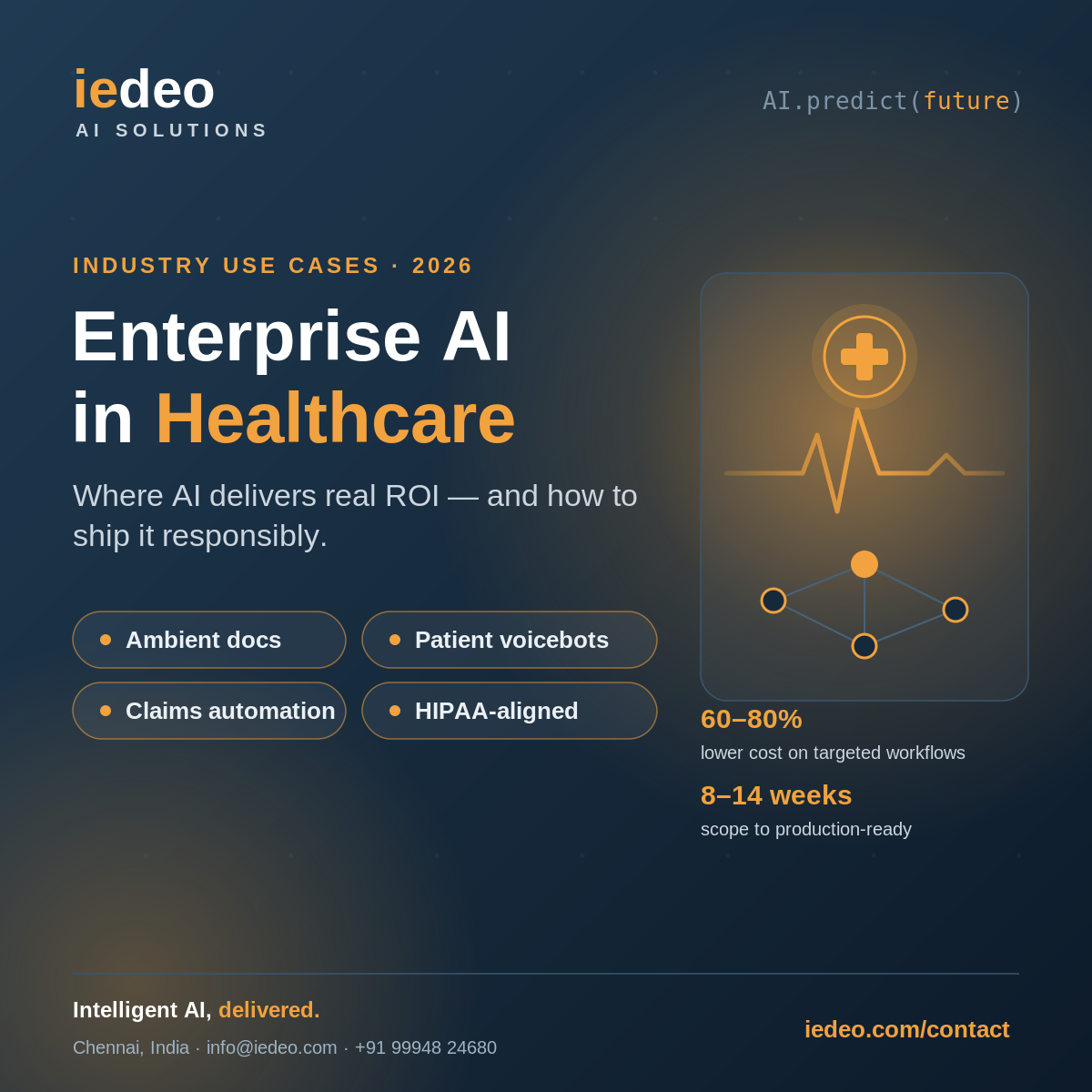
Healthcare leaders spent the last two years asking whether AI was ready for the clinic. In 2026, the question has flipped: where do we deploy it first, and how fast can we prove the return? Ambient clinical documentation has moved from pilot to default, agentic systems are starting to execute governed workflows, and the biggest health systems are signing enterprise-wide AI deals rather than running another sandbox experiment. For hospitals, payers, and healthtech founders, the opportunity is no longer theoretical — but neither are the compliance stakes. This guide breaks down the enterprise AI use cases in healthcare that are delivering measurable value, and how to ship them responsibly.
Why 2026 is healthcare's AI inflection point
Three forces converged this year. First, the technology matured: large language models, multimodal vision, and retrieval-augmented systems are now reliable enough for real clinical and administrative work. Second, the ROI math became clear — organizations are concentrating investment on use cases with strong returns and low clinical risk, like documentation, coding, and revenue-cycle automation. Third, governance frameworks caught up, giving compliance teams a way to say yes. The result is a shift from isolated experiments to enterprise-scale deployment, where AI is embedded directly into the systems clinicians and staff already use every day.
High-impact enterprise AI use cases in healthcare
Ambient clinical documentation
The clearest win is giving clinicians their time back. Ambient documentation tools listen to a patient encounter and draft a structured clinical note, cutting the hours physicians lose to typing. Health systems deploying these tools commonly report large reductions in documentation time and meaningful relief from burnout, while preserving note quality and coding detail. For an enterprise, the value compounds: less after-hours charting, higher clinician retention, and cleaner data downstream.
Patient-facing voicebots and chatbots
Front-desk and call-center load is a perennial drain. AI voicebots and chatbots can handle appointment scheduling, reminders, prescription refill requests, triage routing, and frequently asked questions around the clock. Multilingual support matters enormously here — a voicebot that speaks Tamil, Hindi, English, and Arabic lets a provider serve diverse patient populations without expanding headcount. The goal is not to replace care teams but to remove the repetitive intake work that keeps them on the phone instead of with patients.
Medical document processing and claims automation
Healthcare runs on paperwork: referrals, prior authorizations, insurance claims, lab reports, and intake forms. Intelligent document processing extracts, classifies, and validates this information automatically, then routes it into existing systems. Pairing extraction with agentic, retrieval-grounded reasoning means the system can check a claim against policy rules or flag a missing field before a human ever sees it — compressing cycle times that used to take days into minutes and reducing costly denials.
Computer vision for imaging and operational safety
Beyond the back office, computer vision supports radiology and pathology workflows by triaging studies and highlighting regions of interest for specialists to confirm. On the operational side, vision models monitor for hand-hygiene compliance, fall risk, and restricted-area access. These systems augment clinical judgment rather than replace it, and they create an auditable safety layer across a facility.
Measuring ROI: what actually moves the needle
A pilot proves something is possible; ROI proves it is worth scaling. The strongest healthcare AI business cases tie directly to a measurable baseline: hours of documentation saved per clinician per week, reduction in claim denial rates, average handle time on patient calls, or turnaround time on prior authorizations. Start by instrumenting that baseline before launch, then run a controlled rollout against it. Done well, automation of high-volume administrative work can reduce associated operating costs substantially — often in the range of 60–80% for the targeted process — while freeing skilled staff for higher-value work. The discipline is choosing one workflow with a clear number attached, not boiling the ocean.
Building healthcare AI responsibly
In healthcare, compliance is not a feature you add later. Any deployment touching patient data needs HIPAA-aligned handling, encryption in transit and at rest, role-based access, and full audit trails — alongside GDPR alignment for international operations and SOC 2 controls for the underlying platform. Keep a human in the loop for clinical decisions, document model limitations, and design workflows so that AI recommends and staff confirm. Responsible design is also good business: it is what lets risk and legal teams approve a rollout instead of stalling it.
How Iedeo delivers healthcare AI
Iedeo builds production-ready healthcare AI — voicebots, chatbots, document processing, computer vision, and agentic RAG systems — designed around your compliance requirements from day one, with multilingual support for diverse patient populations. Our teams typically move from scope to a working, production-grade deployment in 8–14 weeks, focusing on the one or two workflows where the ROI is clearest. If you are deciding where AI fits in your healthcare organization, book a free consultation and we will help you map the highest-impact, lowest-risk place to start.