
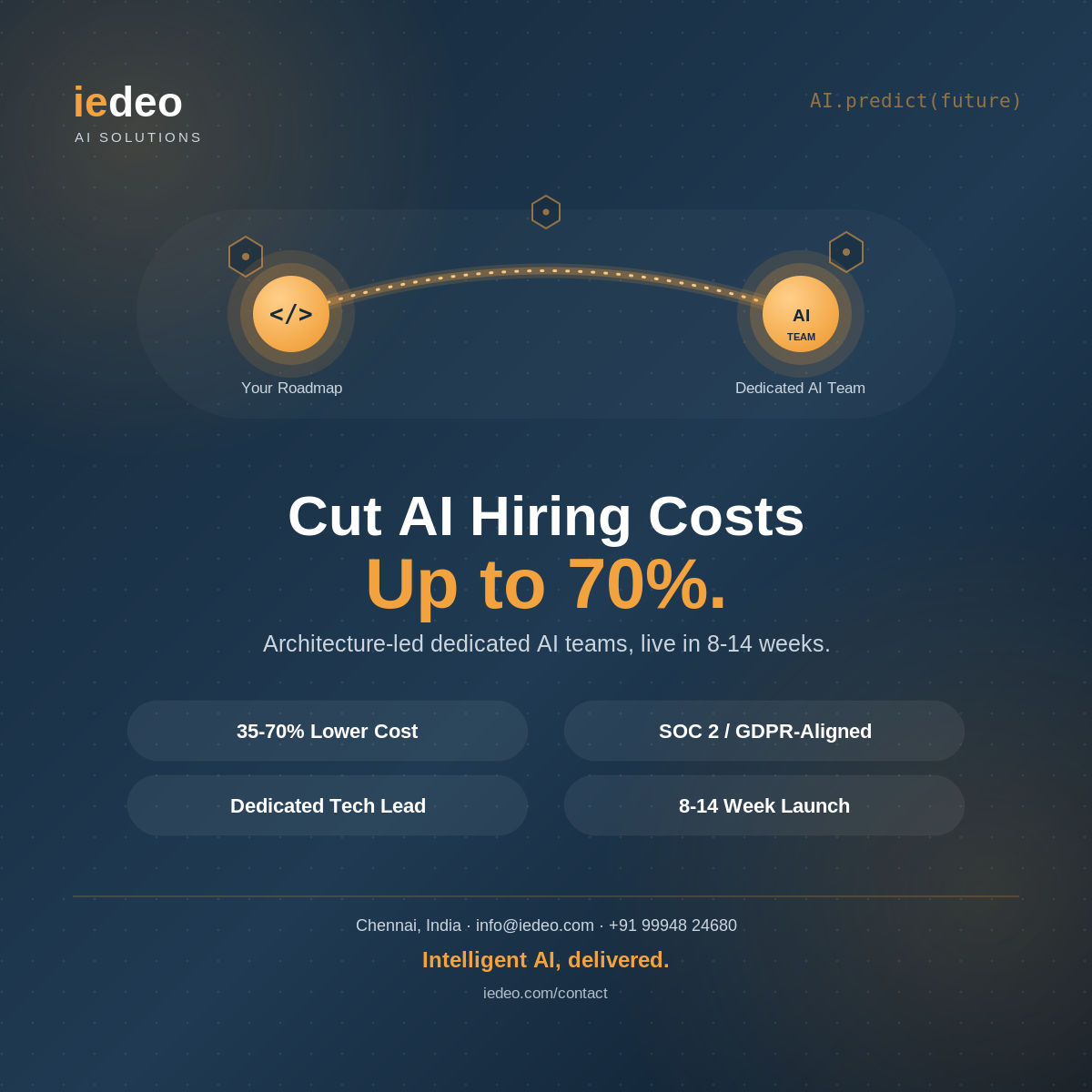
Every CTO budgeting for 2026 is running the same math: AI talent is the single biggest line item in any AI project, typically 60-75% of total spend, and the specialists who can ship production AI — MLOps engineers, agentic-system architects, applied ML engineers — are scarce and expensive wherever you're hiring. That's why dedicated offshore AI development teams are back at the center of the conversation, not as a cost hack, but as the fastest way to get scarce AI skills onto a roadmap without a year-long internal build. The catch: offshore hiring done on rate alone is also how 60% of AI projects end up 30-50% over budget. The difference is how the engagement is structured.
The 2026 Cost Case for Offshore AI Teams
The rate gap hasn't closed. A US-based AI engineer typically costs $45-85 an hour in base salary, and loaded cost — payroll tax, benefits, recruiting — pushes that 25-40% higher before a line of code ships. A fully managed offshore AI developer typically runs $15-25 an hour. Rolled up across a full engagement, offshore AI teams commonly cost 35-70% less than an equivalent in-house team in the US, UK, or UAE, with the widest gaps on senior and specialist roles where domestic supply is tightest.
That gap compounds fast because AI hiring dominates project cost. Shaving 40-60% off the largest line item in an AI budget is a different outcome than the same discount on QA or project management — which is why offshore AI staffing has become a board-level lever rather than a back-office one.
Why "Skill Layer" Thinking Changed the Calculus
The bigger shift in 2026 isn't the rate — it's what companies hire for. Most organizations now build AI capability by upskilling existing engineers on AI tooling rather than staffing a separate AI department, reserving external hiring for roles too deep and scarce to build internally: MLOps engineers, senior LLM and agentic-system architects, and retrieval and evaluation specialists.
That reframes a good offshore engagement. It's rarely "replace our engineering team with a cheaper one" — it's "add the one or two specialist skill sets we can't hire fast enough locally, and let a dedicated team carry a defined product surface end to end."
What a Production-Ready Dedicated Team Looks Like
A dedicated engagement that ships looks different from a body-shop rate card. It includes a tech lead who owns architecture decisions and talks directly with your stakeholders, not a coordinator relaying tickets. It includes the specialists the work needs — an MLOps engineer for deployment and monitoring, an ML or agentic-systems engineer for the model and retrieval layer, QA with AI-specific testing experience. It runs on defined overlap hours with your team, so reviews and incident response don't wait a full day for a handoff. And it operates under the data standards you'd require internally — SOC 2 / GDPR-aligned access controls, NDAs, clear IP assignment — especially once the team touches production data.
The engagements that struggle almost always skipped the security and access review, because it feels like it can wait until after the pilot proves value. It can't, once real data is involved.
Where Dedicated Offshore AI Teams Pay Off Fastest
Startups and mid-market SaaS shipping a first AI feature
Teams adding an AI feature — a chatbot, a recommendation engine, a document workflow — rarely need a permanent AI department for one feature. A dedicated team can scope, build, and hand off a production feature in a single engagement.
Enterprises piloting agentic AI or RAG without headcount risk
Piloting agentic RAG, a voicebot, or computer vision carries real uncertainty about which use case scales. A dedicated team lets an enterprise test that assumption without committing to permanent headcount before the pilot proves out.
Regulated industries needing specialist augmentation
Banking and healthcare teams often have strong engineering benches but no in-house LLM or agentic-systems specialist. A dedicated augmentation model fills that gap inside the existing compliance process.
Product companies scaling a vertical AI product
Companies running a specific product — an exam platform, a school management system, a logistics tool — need sustained AI feature velocity without the overhead of a standalone AI org. A team embedded against the roadmap keeps shipping without that fixed cost.
Common Pitfalls in Offshore AI Hiring
The engagements that underdeliver share the same root causes: picking a partner on rate alone without checking prior production AI work; skipping a shared definition of "done" before work starts; ignoring time-zone overlap, which turns a two-day fix into a two-week one; treating the team as a headcount swap instead of integrating its lead with your engineering leadership; and granting data access before a security review is complete.
Structuring the Engagement: A 30-60-90 Approach
Engagements that go well follow a similar shape: two to three weeks of discovery and setup — scope, architecture review, security provisioning — followed by four to six weeks building and validating a pilot on one scoped product surface. From there, delivery scales, with regular knowledge transfer back to internal engineering so expertise doesn't stay siloed offshore.
Structured this way, most dedicated AI engagements reach a shippable first outcome within 8-14 weeks — comparable to a scoped in-house build, at a materially lower run rate.
The Bottom Line
Offshore AI development in 2026 isn't a cost shortcut bolted onto an existing plan — it's a deliberate way to get scarce AI specialists onto a roadmap at 35-70% lower cost than hiring locally, provided the engagement is scoped, secured, and integrated from day one. The question isn't whether a dedicated AI team can save money; it's which specialist gap on your roadmap it should fill first.
At Iedeo, we provide dedicated AI/ML, web, and mobile development teams — architecture-led, SOC 2/GDPR-aligned, and integrated with your existing engineering leadership — with typical engagements live in 8-14 weeks. If you're weighing whether to hire in-house or bring in a dedicated team, book a free consultation and we'll map the gap worth filling first.