
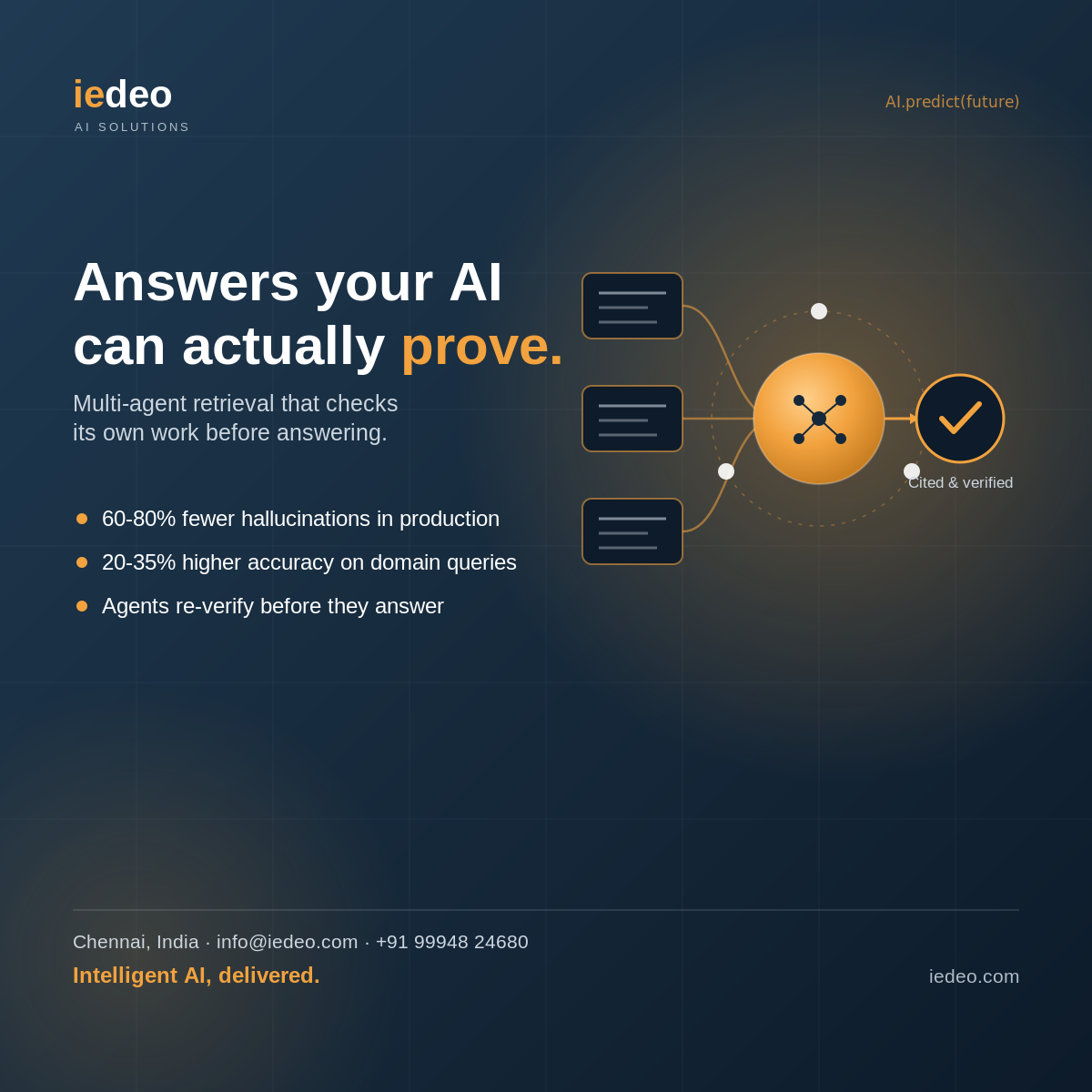
Ask an enterprise chatbot a policy question today and there's a real chance it answers confidently — and wrong. Standard retrieval-augmented generation (RAG) pulls a handful of matching passages and lets the model write around them, and when the retrieval misses or the passages are ambiguous, the model fills the gap with something that sounds right. Nearly 70% of large organizations had rolled out some form of RAG by early 2026, yet 62% of those deployments still deal with hallucination-related incidents at least once a week. Agentic RAG is the architecture shift closing that gap: instead of one retrieval pass and one answer, an agent plans the search, checks what it finds, retrieves again if the evidence is thin, and only answers once it can point to a source.
What agentic RAG actually changes
Classic RAG treats retrieval as a single step: embed the question, fetch the top-k chunks, hand them to the model, done. Agentic RAG treats retrieval as a decision the AI has to justify. A retrieval agent breaks the question into sub-queries, searches multiple sources (documents, knowledge graphs, structured databases), scores how well the evidence actually supports an answer, and triggers a second or third retrieval pass when confidence is low. If the grounding score still doesn't clear a threshold, the system returns "I don't have enough information" instead of guessing — a small design choice that matters enormously in regulated industries, where a wrong-but-confident answer is worse than no answer.
Knowledge graphs add a second layer of checking
The strongest deployments pair agentic retrieval with a knowledge graph rather than plain vector search alone. Graph-grounded retrieval lets the agent verify that a retrieved fact is actually connected to the entities in the question, not just semantically similar to it, which is where a lot of RAG hallucinations originate. Enterprise teams running this combination report hallucination reductions of roughly 60% compared to naive chunk-and-retrieve setups, with some production deployments cutting hallucination rates from the 12-14% range down to under 5%.
Where the numbers are landing in 2026
The gains show up in both trust and cost. Organizations using agentic and graph-grounded RAG report 20-35% higher accuracy on domain-specific benchmarks compared to single-pass retrieval, and some large deployments have cut factual errors from roughly 18 per 100 queries to under 7. On the cost side, RAG-based grounding is reported at up to 90% cheaper than continuously fine-tuning a model to "know" the same information, since the knowledge lives in retrievable documents rather than model weights that need retraining every time policy changes. Customer support, internal knowledge search, and compliance Q&A are consistently the highest-ROI use cases, because the volume of repetitive questions is high and the cost of a wrong answer is easy to quantify.
Why hallucinations still happen even with RAG
RAG alone doesn't guarantee accuracy — it just changes where errors come from. The most common causes are retrieval that returns the wrong document because of weak search relevance, documents that are outdated or contradict each other, and models that blend retrieved facts with their own prior knowledge instead of sticking strictly to what was retrieved. Agentic RAG addresses the first two by adding verification and re-retrieval steps; the third requires explicit grounding checks that compare the generated answer back against the source text before it's shown to a user, and reject or flag answers that drift from their sources.
What to check before you build or buy
A few questions separate a system your team will trust from one that quietly erodes trust after the first bad answer:
- Does it cite its sources, and can a user click through to verify the original document?
- Does it have an explicit "I don't know" path, or does it always produce an answer regardless of evidence quality?
- Is retrieval grounded in a knowledge graph or structured relationships, or purely vector similarity?
- How does it handle conflicting or outdated documents in the same knowledge base?
- Can it plug into the systems where your knowledge actually lives — SharePoint, Confluence, ticketing systems, internal wikis — without a lengthy migration?
Getting from pilot to production
A production-ready agentic RAG deployment for a single well-scoped domain, such as internal IT knowledge search or customer support deflection, is realistically an 8-14 week build: time to structure the knowledge base and build the retrieval and grounding pipeline, tune it against real historical questions, and validate accuracy against a held-out set before rollout. The teams getting the most value aren't trying to build a system that answers everything on day one. They're scoping one knowledge domain, proving the grounding and citation behavior in production, and expanding once users trust what comes back.
If you're weighing where to start, book a free consultation and we'll help you scope where agentic RAG pays off first.