
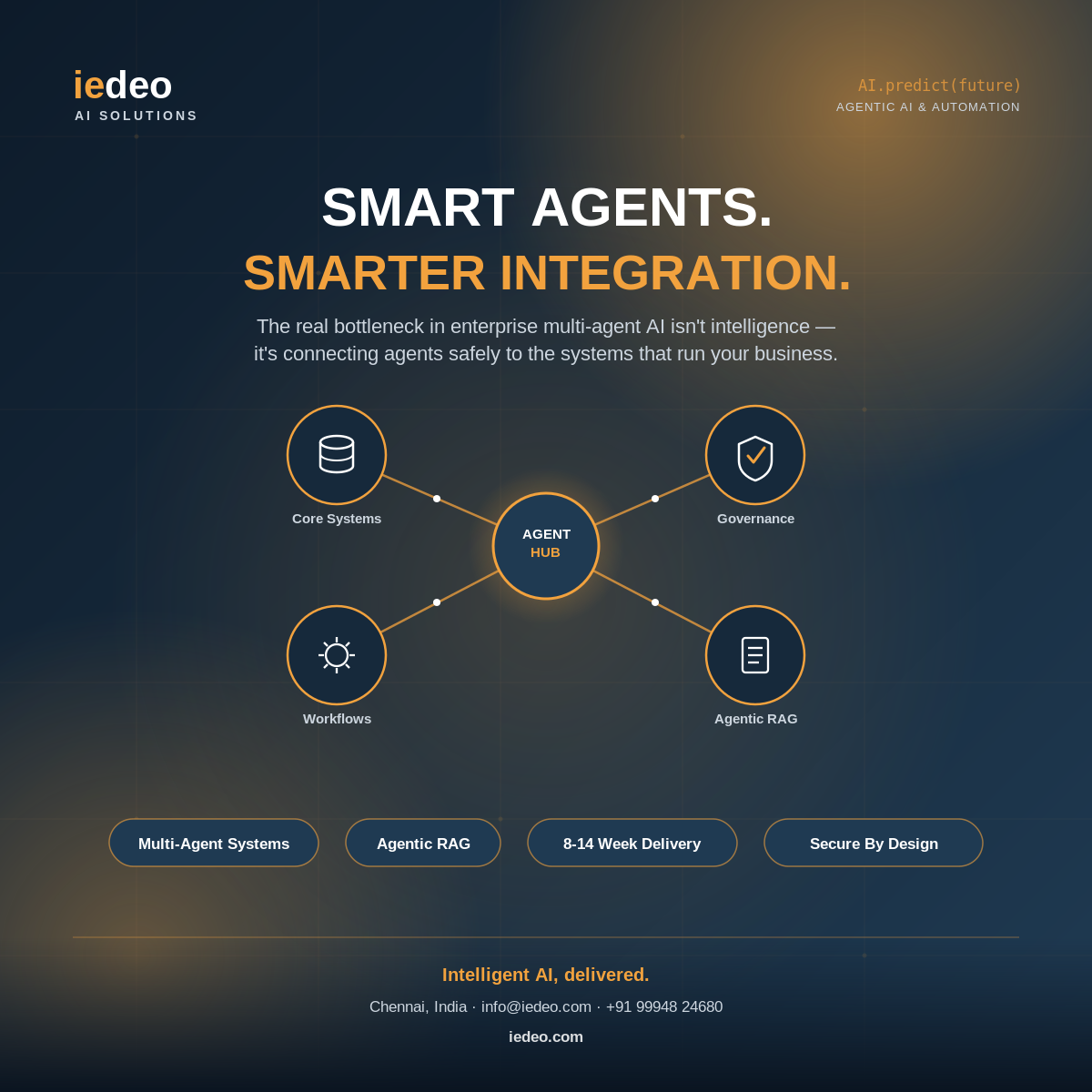
Enterprise AI has quietly shifted its center of gravity. Two years ago, the conversation was about retrieval-augmented generation — bolting a knowledge base onto a language model so it could answer questions accurately. In 2026, that conversation has moved on. The question CTOs and founders are asking now isn't "can our AI find the right document?" It's "can our AI agents actually get work done, end to end, without a human stitching the steps together?" That shift, from single-purpose RAG to coordinated multi-agent systems, is where most enterprise AI budget is going this year. It's also where most projects quietly stall.
Why multi-agent AI is having its moment
Surveys of enterprise AI leaders this year consistently show the same pattern: the majority of organizations already run multi-step agent workflows in some form, and a meaningful share have progressed to agents that span more than one team or system. Momentum is real. Application teams are shipping agent-embedded features far more often than they were even eighteen months ago, and appetite to push into more complex, cross-functional agent use cases keeps growing.
But adoption numbers hide an uncomfortable second statistic: a large governance and reliability gap sits underneath that growth. Plenty of organizations have an agent "in production" in the loosest sense — a pilot, a narrow assistant, a proof of concept wired into one system. Far fewer have multiple agents reliably coordinating real work with the oversight a regulated business needs.
The real bottleneck isn't model intelligence
Ask enterprises what's actually slowing them down, and the answer is rarely "the model isn't smart enough." It's integration with existing systems. That tracks with what we see building AI systems for clients across banking, healthcare, logistics, and retail: the underlying models are capable enough today. What's hard is giving an agent secure, reliable access to the core banking platform, the EHR, the warehouse management system, or the claims database — and trusting it to act correctly inside those systems without a human re-checking every step.
Three integration failure points we see repeatedly
Authentication and permissions treated as an afterthought. Teams prototype an agent against a sandboxed API key with far more access than the use case needs, then discover at production readiness review that scoping proper least-privilege credentials means redesigning half the workflow.
No clear line between "agent proposes" and "agent executes." The projects that stay stuck in pilot purgatory are usually the ones that never decided, concretely, which actions an agent can take autonomously versus which ones need a human approval step. Deciding this late, rather than at design time, is expensive.
Legacy systems with no clean API surface. A surprising share of the "integration problem" is really a data-access problem: mainframes, on-prem ERPs, and older core systems that were never built to be called programmatically. Solving this usually means a thin middleware layer, not a smarter agent.
What a working multi-agent architecture actually looks like
A production-grade setup generally has four layers working together, not one clever prompt doing everything.
Orchestration
A coordinating layer that breaks a request into subtasks and routes each to the right specialist agent — one for retrieval, one for a specific system action, one for compliance checks — rather than asking a single agent to do it all.
Guarded tool and action layer
Every action an agent can take against a live system is wrapped with explicit permissions, rate limits, and audit logging, so "the agent did something wrong" is always traceable to a specific, reviewable action.
Retrieval and memory (Agentic RAG)
Instead of static document retrieval, agents pull context dynamically, cross-check sources, and can request more information before answering — reducing the confident-but-wrong failure mode that hurt earlier RAG deployments.
Human-in-the-loop checkpoints
High-stakes or irreversible actions — money movement, medical record changes, contract commitments — route through a human approval step by default, with the option to tighten or loosen that threshold as trust in the system builds.
Time to value: what to expect
Industry data puts the median time-to-value for enterprise agent deployments at a little over five months, with narrower, well-scoped use cases like sales development agents paying back faster and broader operational agents taking longer. That timeline is heavily influenced by exactly the integration issues above. Our own delivery model for production-ready multi-agent and Agentic RAG systems targets 8-14 weeks, largely because we scope the systems-integration work up front rather than treating it as a late-stage surprise.
Where multi-agent AI pays off first
In banking and financial services, multi-agent setups are handling document-heavy workflows — loan processing, KYC checks, reconciliation — where one agent gathers information, another validates it against policy, and a human signs off on exceptions. In healthcare, similar patterns show up in intake, prior authorization, and records summarization, with strict human review on anything touching a diagnosis or treatment decision. Logistics and retail teams are using coordinated agents for exception handling in fulfillment and inventory, where the volume of edge cases makes manual triage genuinely expensive.
Getting started without over-engineering
The organizations making real progress aren't the ones building the most sophisticated agent architecture. They're the ones being disciplined about scope. Pick one workflow with a clear boundary and a measurable outcome. Decide upfront which steps the agent can take unsupervised and which need sign-off. Instrument everything before you scale to a second use case, so you have real data — not a demo — to justify the third and fourth. Multi-agent AI rewards teams that treat integration and governance as the actual engineering problem, not a compliance checkbox to handle later.
If you're weighing where a multi-agent or Agentic RAG system would earn its keep in your organization, book a free consultation and we'll walk through a scoped, production-ready path for your specific workflow.