
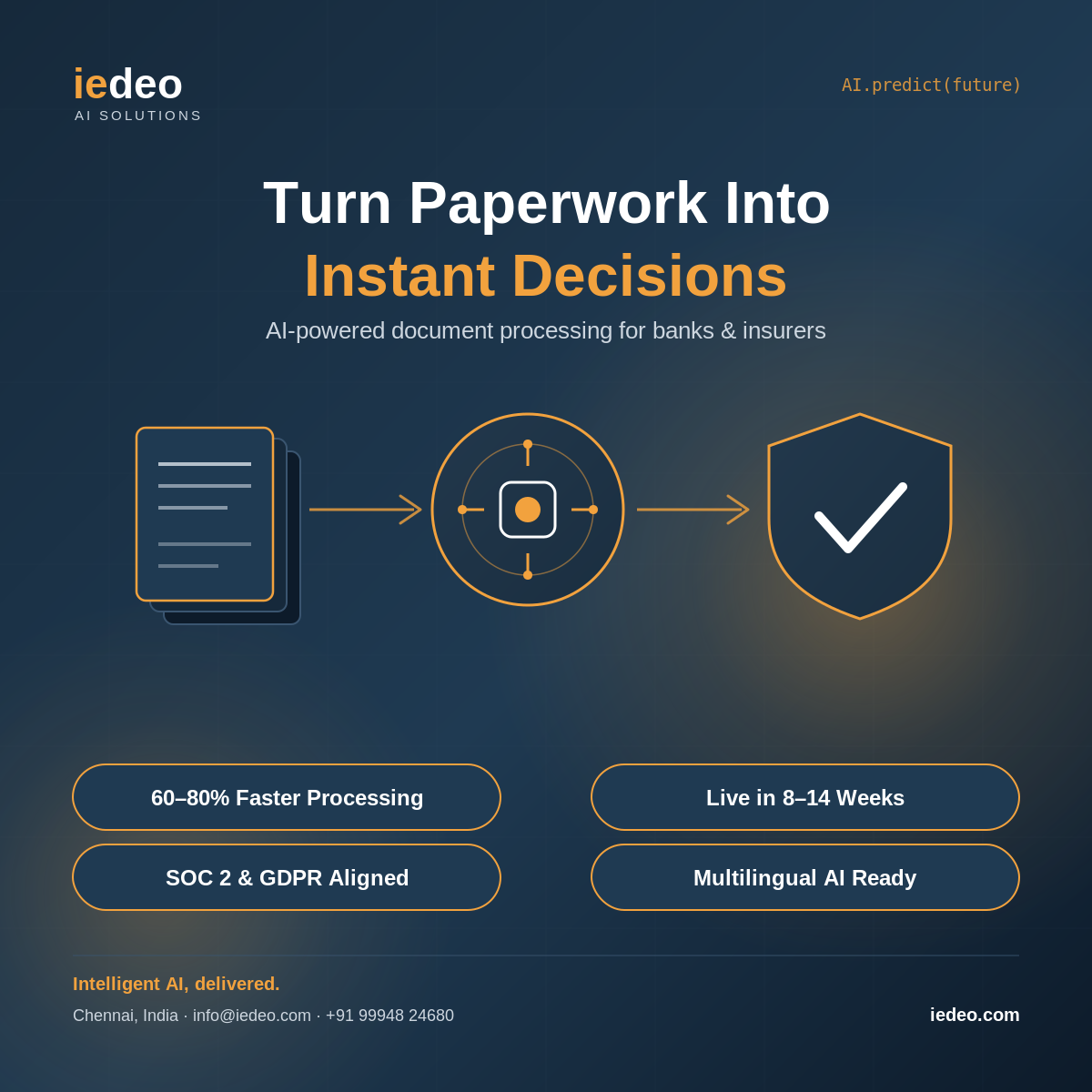
Banks and insurers still lose weeks to paperwork. A mortgage file passes through six pairs of hands before approval. A claims adjuster re-keys the same policy number from a PDF into three different systems. Compliance teams spend Friday afternoons manually checking KYC documents that were uploaded on Monday. None of this is a technology limitation anymore — it's an implementation gap. Intelligent document processing (IDP), built on modern AI rather than legacy OCR, closes that gap in weeks, not years.
The Real Cost of Manual Document Processing
Every unstructured document — a scanned loan application, a handwritten claims form, an emailed W-2 — creates a hidden tax on financial and insurance operations. Staff spend hours classifying, extracting, and validating data that a well-trained AI model can process in seconds. Industry benchmarks for financial services IDP deployments consistently show 60-80% reductions in processing time and comparable cost savings once a pipeline is production-ready, with typical payback inside 6-12 months.
Where the hours go
The bottleneck usually isn't the first read of a document — it's the exceptions. Illegible handwriting, inconsistent form layouts, multi-page contracts with embedded tables, and documents in Tamil, Hindi, Arabic, or English within the same queue. Rules-based OCR tools break down exactly here, which is why so many "automation" projects quietly revert to manual review.
What Intelligent Document Processing Actually Does
Modern IDP combines computer vision, layout-aware extraction models, and large language models to read a document the way a trained analyst would — understanding context, not just pixels. Instead of rigid templates, the system learns document structure, cross-checks extracted fields against source systems, and flags genuine anomalies for human review rather than routing every file to a queue.
From OCR to agentic understanding
The newer generation of IDP pairs extraction with an agentic layer: once data is pulled from a document, an AI agent can validate it against a policy database, check for missing signatures or riders, and trigger the next workflow step — updating a core banking system, opening a claims case, or generating a compliance exception ticket — without a human touching the file unless something looks wrong.
Where Banks and Insurers See the Fastest Wins
Loan and mortgage underwriting
Income statements, tax returns, bank statements, and title documents get extracted and cross-validated automatically, cutting underwriting cycle time and reducing the back-and-forth that frustrates applicants.
Claims intake and adjudication
First Notice of Loss forms, medical bills, repair estimates, and police reports are classified and routed the moment they arrive, so adjusters spend their time on judgment calls instead of data entry.
KYC, AML, and compliance document review
Identity documents, proof of address, and beneficial ownership filings are validated against watchlists and internal policy automatically, with a full audit trail for regulators.
A Realistic Implementation Roadmap
Production-ready IDP for a single high-value workflow — say, mortgage document intake or claims FNOL — is typically achievable in 8-14 weeks: two to three weeks to map document types and exceptions, four to six weeks to build and tune extraction and validation models against real (anonymized) samples, and the remainder for integration testing with core systems and a supervised go-live. Starting with one workflow, proving the ROI, then expanding is far more reliable than a big-bang rollout across every document type at once.
Security, Compliance, and Data Residency
For regulated institutions, the AI layer has to meet the same bar as the rest of the stack: SOC 2 and GDPR-aligned handling, encryption in transit and at rest, role-based access to extracted data, and — for institutions operating across India, the US, UK, Europe, and the Middle East — attention to where data is processed and stored. None of this is optional, and it shouldn't be bolted on after a pilot succeeds; it needs to be part of the architecture from day one.
Measuring ROI Beyond Headcount
The easiest number to report is hours saved, but the more durable ROI shows up elsewhere: faster time-to-decision for customers, fewer compliance exceptions found in audits, lower error rates in downstream systems, and staff redeployed from data entry to underwriting judgment and customer service. Track all four, not just the labor line, when building the business case for expansion.
Document backlogs are a solvable problem, not a permanent cost of doing business in financial services. If your team is still routing PDFs through manual queues, book a free consultation to scope a pilot workflow and see a realistic timeline and cost model for your document volumes.