Online exams have a new integrity problem, and it isn't a student whispering an answer to a friend. It's a browser tab quietly open to an AI chatbot, a phone propped just out of webcam view, or a second screen mirroring a language model's answer in real time. Traditional proctoring — a webcam feed and a human watching for wandering eyes — was built for the cheating of five years ago. In 2026, exam integrity has to catch AI-assisted cheating specifically, and that takes a fundamentally different detection stack than a locked-down browser and a live video feed.
AI-Assisted Cheating Looks Nothing Like Old-School Cheating
Surveys of online test-takers over the past two years have repeatedly found a large share of students admitting they've tried using ChatGPT or a similar tool during a proctored exam — often just to check or generate an answer, not to cheat wholesale. That's a different threat model than a hidden note card. It's fast, hard to see on a webcam feed alone, and doesn't require leaving the exam window if the platform isn't watching for it. Reported cheating attempts using AI tools and secondary devices have climbed sharply industry-wide over the past few years, which is why exam platforms built for the pre-ChatGPT era are struggling to keep pace.
From "Watch the Webcam" to Multi-Signal Detection
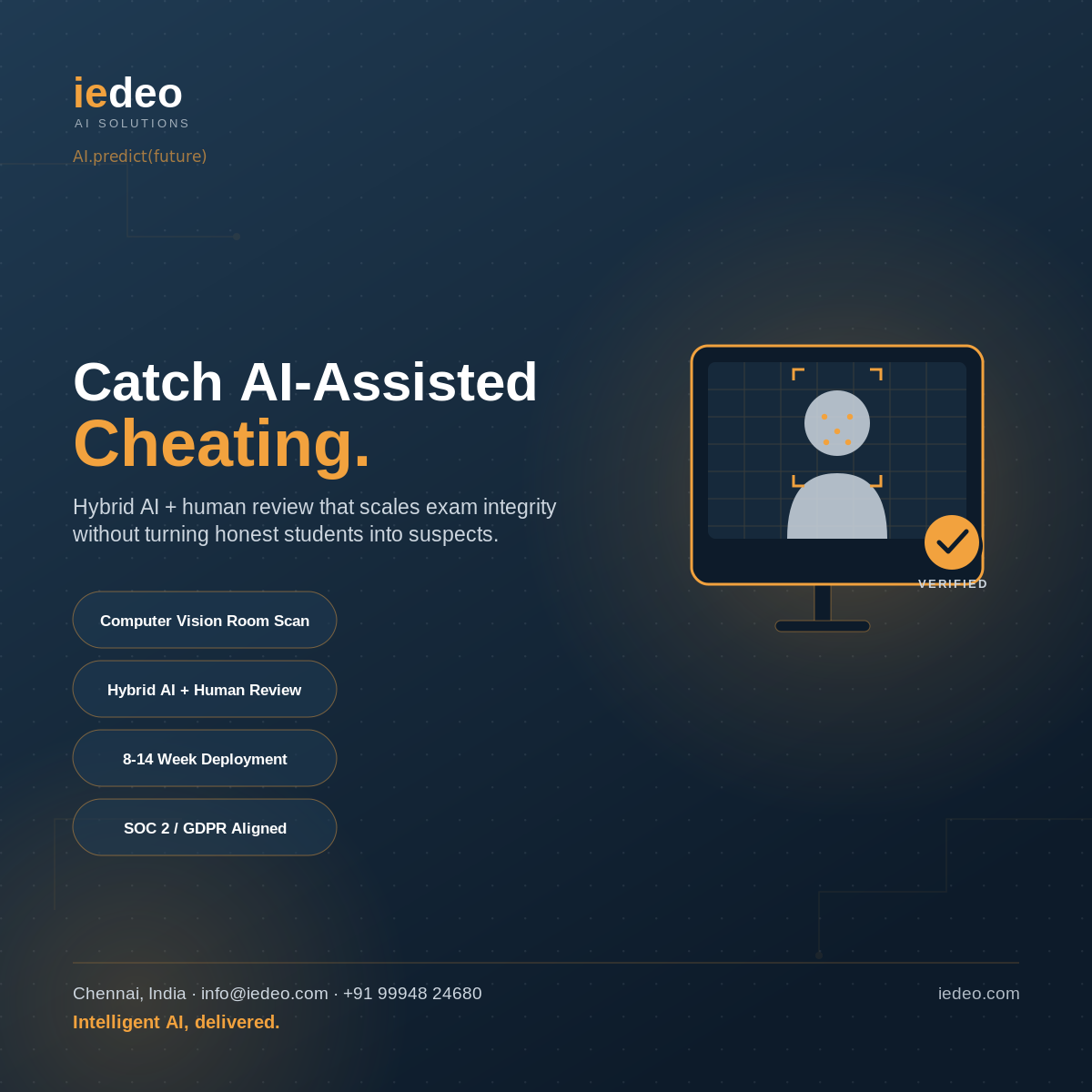
A single video feed can't catch a second monitor, a phone under a desk, or a person feeding answers from off-camera. Newer proctoring systems layer several signals together: computer vision that builds a rough 3D map of the room from a standard webcam to flag unauthorized devices or a second person entering the frame, gaze and attention tracking that flags sustained off-screen focus, browser lockdown that blocks tab-switching and clipboard access, and behavioral analytics that flag typing or answer patterns inconsistent with a student's own writing style earlier in the exam. No single signal is proof of cheating on its own — the value is in combining them into a confidence score a human can review quickly.
Why Hybrid Proctoring Is Winning Over Pure AI or Pure Human Review
Fully automated proctoring generates false positives — a student glancing at a clock or a sibling walking through the room shouldn't trigger an academic integrity case. Fully human proctoring doesn't scale past a modest cohort size. The model gaining ground in 2026 is hybrid: AI flags anomalies across every session in real time, and a trained human reviewer confirms or dismisses each flag before any action is taken against a student. This keeps the process both scalable and defensible — institutions can show a clear, auditable trail from flag to human decision, which matters enormously if a result is ever contested.
Where This Matters Most
Certification and licensing bodies run high-stakes exams where a compromised result carries real professional consequences, and need airtight audit trails to defend contested results.
Universities and online degree programs are proctoring at a scale that makes fully manual review impractical, while facing the highest exposure to AI-assisted cheating among tech-fluent students.
School boards running entrance or board exams need multilingual proctoring and detection tuned for large cohorts sitting the same exam simultaneously, often across many remote locations at once.
Building Exam Integrity That Holds Up to Scrutiny
A few practices separate proctoring systems that actually hold up from ones that generate disputes: combine technology with assessment design, since open-book-friendly question formats reduce the incentive to cheat in the first place; keep the flagging process transparent, so students know what triggered a review and can respond to it; maintain a full audit trail from raw signal to human decision, not just a final flag; and treat webcam and biometric-adjacent data with the same privacy discipline as any other sensitive personal data, with clear retention and deletion policies.
The Bottom Line
The exam integrity problem in 2026 isn't wandering eyes — it's a student quietly getting an AI-generated answer without ever looking suspicious on camera. Institutions that are winning this fight have moved past single-signal webcam monitoring to hybrid AI-plus-human systems that catch AI-assisted cheating without turning every legitimate exam-taker into a suspect.
At Iedeo, we build AI-powered exam and assessment platforms — including iDoExam, our computer-vision-based proctoring and automation product — for universities, certification bodies, and school systems across India, the US, and the Middle East. If your current exam platform wasn't built for the AI era, book a free consultation and we'll walk through what a hybrid detection stack would look like for your exams.