
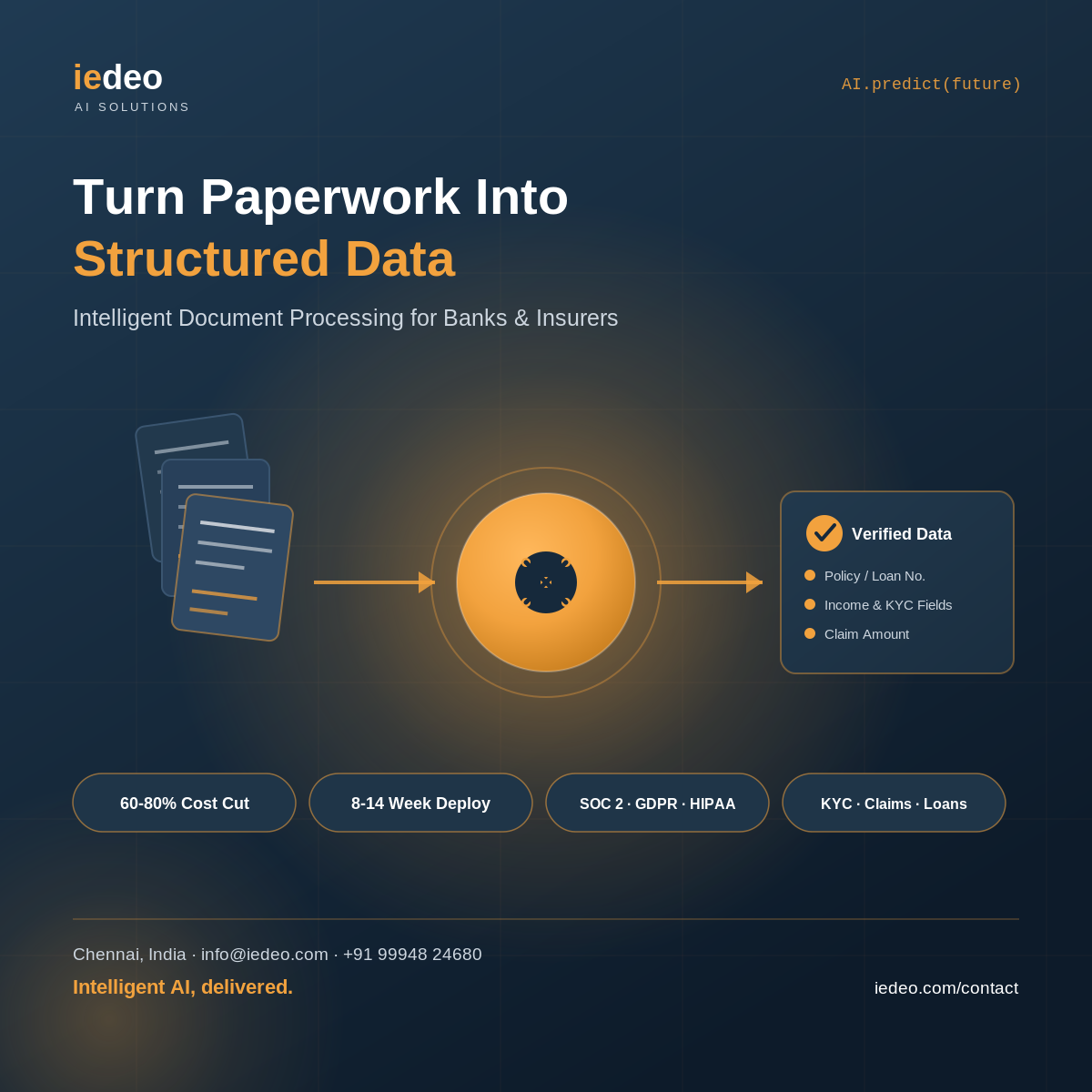
Every bank and insurer runs on paper — loan applications, KYC files, claims forms, policy documents, compliance filings. Most of it still gets read, keyed, and cross-checked by hand. Intelligent document processing (IDP) is the AI layer that changes that: it reads unstructured documents the way a trained analyst would, extracts the fields that matter, validates them against business rules, and routes exceptions to a human — at a fraction of the time and cost.
The Document Bottleneck in Banking and Insurance
A single mortgage file can run to hundreds of pages across pay stubs, tax returns, title documents, and disclosures. A single insurance claim might include a police report, medical records, repair estimates, and photos. Processing each one manually means data-entry teams, multiple review passes, and turnaround times measured in days rather than minutes.
This isn't just a cost problem. Slow document processing shows up as delayed loan approvals, frustrated policyholders, and compliance teams scrambling to reconstruct audit trails. In regulated industries, the paperwork bottleneck is also a customer-experience and risk problem.
What Intelligent Document Processing Actually Does
IDP goes well beyond basic OCR. A modern pipeline combines computer vision, natural language processing, and machine learning to:
Classify documents automatically
Incoming files — scanned, photographed, or digital — get sorted by type (pay stub, W-2, claim form, ID) without a human touching them first.
Extract structured data
Names, dates, amounts, policy numbers, and clauses are pulled out and mapped into the fields your loan origination system, claims platform, or core banking system actually needs.
Validate against business rules
Extracted data is checked for consistency — does the income on the pay stub match the application? Is the ID expired? Does the claim amount fall within policy limits? — before it ever reaches a caseworker.
Route exceptions intelligently
Anything that fails validation, looks unusual, or falls outside confidence thresholds gets flagged and routed to a human reviewer, with the reasoning attached.
The ROI Case: What Financial Services Teams Actually See
Document automation has moved past the pilot-project stage. Financial services deployments typically report 60-80% reductions in document processing time and cost once IDP is running in production, with well-scoped projects reaching positive ROI within 10-14 months. The savings compound because the same system that speeds up processing also reduces the rework caused by manual data-entry errors — a cost that rarely shows up on the initial business case but adds up fast in high-volume operations.
The bigger shift is where document AI now sits in the process. It used to be a back-office efficiency play. Increasingly, it's the front door: the speed at which a bank can approve a loan or an insurer can settle a claim is becoming a direct driver of customer retention.
Where IDP Delivers the Fastest Wins
Loan and mortgage origination
Income verification, asset documentation, and disclosure processing compressed from days to hours, with fewer stipulations bouncing back to the borrower.
Claims processing
First notice of loss, medical bills, and repair estimates extracted and cross-checked automatically, so adjusters spend their time on judgment calls, not data entry.
KYC and AML document verification
ID documents, proof of address, and beneficial ownership filings validated against watchlists and internal rules as part of onboarding, not after it.
Regulatory reporting
Data pulled consistently from source documents reduces the manual reconciliation work that regulatory filings usually demand.
Compliance and Human Oversight Aren't Optional
Banking and insurance are regulated for good reason, and document AI has to be built with that in mind from day one. That means SOC 2, GDPR, and HIPAA-aligned handling of sensitive data, full audit trails on every extraction and decision, and — critically — a human in the loop for anything low-confidence or high-stakes. The goal of IDP isn't to remove people from the process; it's to remove the repetitive reading and typing so people can spend their time on the decisions that actually need judgment.
Getting From Pilot to Production
The biggest reason IDP projects stall isn't the technology — it's trying to boil the ocean on day one. The projects that succeed start with a single high-volume document type (KYC intake or first notice of loss are common starting points), get it to production quality, and expand from there. A well-scoped IDP deployment can go from kickoff to production in 8-14 weeks, including integration with existing loan origination, claims, or core banking systems, and multilingual support where a workforce or customer base needs it.
If your team is still routing PDFs to a data-entry queue, the technology to change that is production-ready today. Book a free consultation to scope what an IDP pilot would look like for your document volumes.