
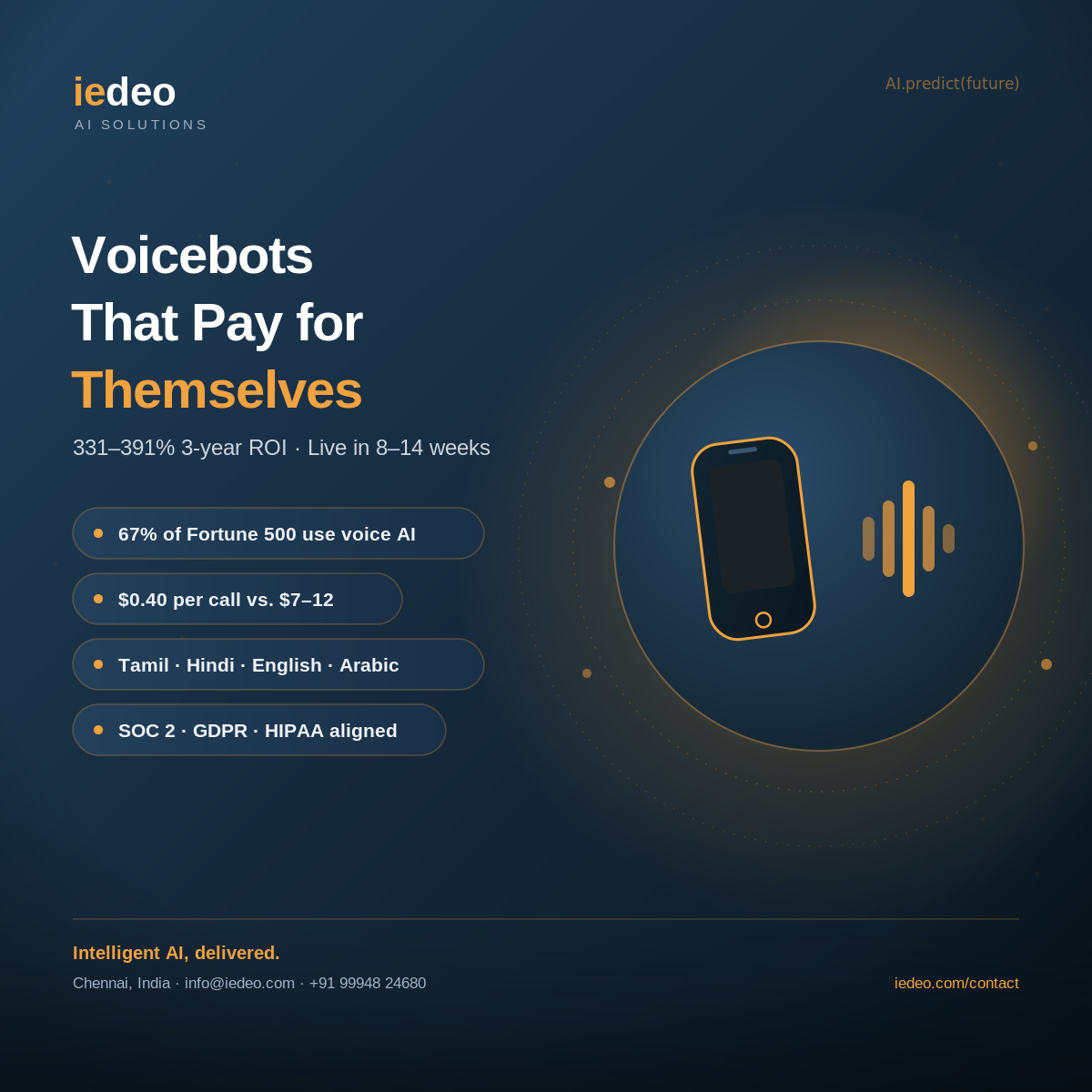
Ask a Fortune 500 CTO what changed in their contact center this year, and voice AI comes up before anything else. Enterprise voicebots have moved past the pilot stage: 67% of Fortune 500 companies now run production voice AI systems, and production voice agent deployments grew 340% year-over-year. The pitch used to be "AI that sounds human." The pitch in 2026 is "AI that pays for itself in under six months." For founders and CTOs evaluating where to spend the next automation budget, voicebots have become one of the clearest, most measurable bets in enterprise AI.
The ROI Case for Enterprise Voicebots
The numbers behind this shift are hard to ignore. Enterprises running production voice AI report a three-year ROI between 331% and 391%, typically with payback inside six months. The unit economics explain why: an automated voice interaction costs roughly $0.40 per call, against $7 to $12 per call for a human agent. At scale, that gap compounds fast — industry estimates put the 2026 reduction in contact-center labor costs from conversational AI at roughly $80 billion. Average handle time drops 35-40% alongside the cost savings, because a well-built voicebot doesn't put callers on hold to look something up; it already has the answer.
None of that means voicebots replace people. The enterprises seeing the strongest returns use voice AI to absorb the repetitive 60-70% of call volume — order status, appointment scheduling, balance checks, FAQs — and route everything ambiguous or emotionally charged to a human, with full context already attached.
Where Voicebots Pay Off Fastest
Not every use case returns value at the same speed. Four patterns consistently lead:
Banking and financial services
Balance inquiries, card activation, fraud alerts, and payment reminders are high-volume, low-ambiguity calls — ideal for a first voicebot deployment, with strict authentication and compliance built in from day one.
Healthcare
Appointment scheduling, prescription refill requests, and pre-visit intake let a voicebot handle scheduling logistics 24/7, while HIPAA-aligned handling keeps patient data protected.
Retail and e-commerce
Order tracking, return initiation, and product availability checks are exactly the high-frequency, low-complexity calls that erode margins when handled manually at scale.
Logistics
Shipment status, delivery rescheduling, and dock appointment booking are naturally voice-first interactions that many logistics operations still route through slow phone trees.
What Makes a Voicebot Production-Ready
The gap between a voicebot demo and a voicebot enterprises actually trust with customers comes down to a handful of non-negotiables. It needs to handle real accents and interruptions gracefully, not just clean scripted audio. It needs multilingual coverage that matches your customer base — Tamil, Hindi, English, and Arabic are now standard requirements for teams serving India, the Middle East, and global markets from one platform. It needs SOC 2 / GDPR / HIPAA-aligned data handling, since every call may touch personal or financial information. And it needs a clean handoff to a human agent, with the full conversation transcript and intent already passed along, so customers never repeat themselves.
Integration matters just as much as the voice model. A voicebot that can't read from and write to your CRM, ticketing system, or core banking platform is a chatbot with a phone number — it can talk, but it can't act.
The 8-14 Week Rollout Path
Enterprises that succeed with voice AI tend to follow a similar sequence. They start with one call type — usually the highest-volume, lowest-ambiguity flow — rather than trying to automate the whole IVR tree at once. They connect the voicebot to existing systems of record before expanding scope, so early conversations reflect real account data. They run a shadow period where the bot listens and drafts responses without going live, giving the team a chance to catch edge cases. And they define clear escalation triggers upfront: sentiment shifts, repeated confusion, and specific keywords that should always route to a human.
Done this way, a production-ready enterprise voicebot typically launches in 8-14 weeks, with cost reductions of 60-80% on covered call types once the deployment is fully ramped.
Common Pitfalls to Avoid
The projects that underdeliver tend to make the same mistakes: launching with too broad a scope, skipping the shadow-mode testing phase, underinvesting in multilingual accuracy for markets that need it, or treating compliance as a post-launch checklist item instead of a design constraint. Voice AI is unforgiving of shortcuts in a way text-based chatbots often aren't — a confused caller hangs up, while a confused chat user might just wait a beat longer.
The Bottom Line
Voicebots are no longer an experimental line item — they're one of the fastest-payback investments available to enterprise teams in 2026, provided they're scoped narrowly, integrated properly, and built compliant from the start. The question worth asking isn't whether voice AI belongs in your operations; it's which call flow should go live first.
At Iedeo, we build enterprise voicebots — multilingual, SOC 2/GDPR/HIPAA-aligned, and integrated with your existing systems — live in 8-14 weeks. If you're weighing where voice AI fits your operation, book a free consultation and we'll map the highest-ROI call flow to start with.