
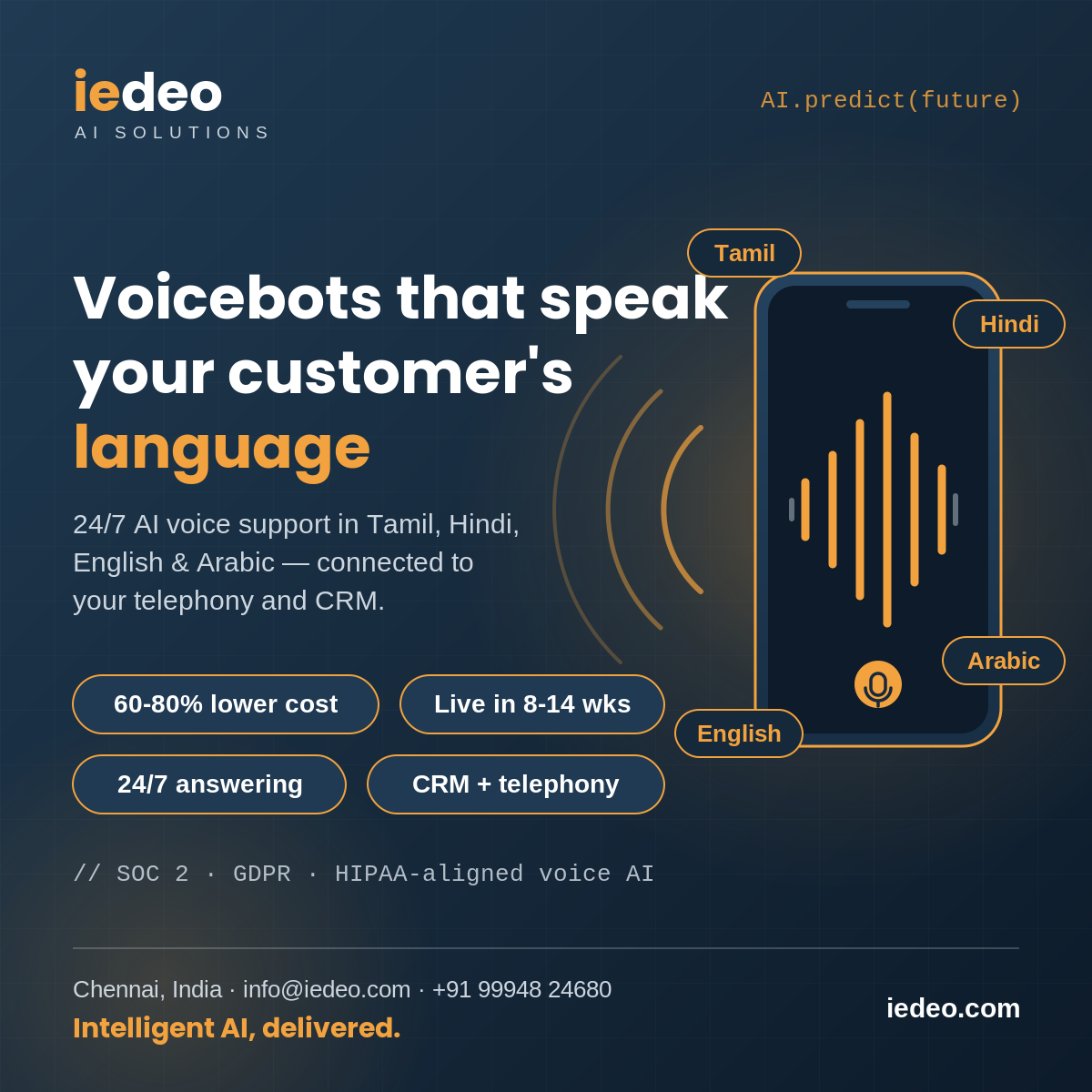
Every enterprise contact center faces the same math: call volumes keep climbing, agent hiring can't keep pace, and customers in India, the Middle East, and beyond expect support in their own language. In 2026, multilingual AI voicebots have moved from experiment to infrastructure — answering calls in Tamil, Hindi, English, and Arabic with natural, human-like conversations, around the clock. For founders and CTOs weighing the investment, here is what actually matters: what voicebots can reliably do today, what they cost to run, and how to get one into production without a year-long science project.
What a Modern AI Voicebot Actually Does
A voicebot is not the touch-tone IVR your customers hate. Modern systems combine speech recognition, large language models, and text-to-speech into a pipeline that understands free-form speech, holds context across a conversation, and takes real actions — checking an order, booking an appointment, verifying an account, or raising a ticket in your CRM.
The practical capabilities that matter for enterprise buyers:
Natural conversation, not menu trees
Callers speak normally ("I paid twice for my last order") and the bot resolves intent, asks clarifying questions, and completes the task. No "press 3 for billing."
True multilingual support
A single bot can greet in English, switch to Tamil mid-call when the caller does, and log the interaction in English for your team. For businesses serving India and the UAE, Tamil, Hindi, and Arabic coverage is often the difference between adoption and abandonment.
System integration
Voicebots earn their keep when they connect to your telephony (SIP, Twilio, Exotel), CRM, and core systems. A bot that can only chat is a demo; a bot that can act is an employee.
Where Voicebots Pay Off First
Across banking, healthcare, retail, and logistics, the highest-ROI starting points are consistent:
- Routine inbound calls — balance inquiries, order status, delivery tracking, appointment scheduling. These are high-volume, low-complexity, and typically make up the majority of contact center traffic.
- After-hours coverage — a voicebot answers at 2 a.m. without night-shift staffing, which matters for global customer bases across time zones.
- Outbound reminders and confirmations — payment reminders, appointment confirmations, delivery scheduling. Predictable scripts, measurable outcomes.
- Overflow and peak handling — festival-season retail spikes or month-end banking surges no longer mean 40-minute hold times.
Deflecting routine calls to a well-built voicebot commonly reduces per-interaction handling costs by 60-80% compared to fully agent-handled calls, while human agents move up the value chain to complex, empathy-heavy cases.
The Honest Economics
Voicebot projects have two cost layers: build and run. The build covers conversation design, integrations, telephony setup, and testing across accents and languages. Running costs scale with call minutes — speech recognition, LLM inference, and text-to-speech are metered.
Three practices keep the economics healthy:
Start with a narrow scope
One or two call types, done end-to-end, beat twenty intents done poorly. Expand after containment rates prove out.
Measure containment, not just calls answered
The metric that matters is the percentage of calls fully resolved without human handoff. Well-scoped deployments typically reach strong containment on routine intents within the first quarter of operation.
Design the handoff
Every voicebot needs a graceful path to a human — with full context transferred so the caller never repeats themselves. This single design choice drives more customer satisfaction than any model upgrade.
Security and Compliance Are Not Optional
Voice interactions carry personal data — names, account details, sometimes health or financial information. Enterprise deployments should be SOC 2-aligned, GDPR-compliant for European callers, and HIPAA-aligned where health data is involved. Ask any vendor how call recordings are stored, where transcripts live, how long data is retained, and whether PII is redacted before it reaches third-party models. If the answers are vague, keep looking.
A Realistic Path to Production
A production voicebot does not require a year. A typical delivery arc runs 8-14 weeks: discovery and call-flow analysis in the first two weeks, conversation design and integration builds through the middle stretch, then accent testing, pilot traffic, and a staged rollout. The teams that succeed treat the first 90 days after launch as part of the project — tuning prompts, expanding intents, and reviewing edge cases weekly.
The Bottom Line
Multilingual voicebots are no longer a bet on future technology; they are an operating decision about cost, coverage, and customer experience. The winners in 2026 are not the companies with the flashiest demos — they are the ones that scoped tightly, integrated deeply, and measured containment honestly.
At Iedeo, we build production voicebots that speak Tamil, Hindi, English, and Arabic, integrate with your telephony and CRM, and ship in 8-14 weeks. If rising call volumes are squeezing your team, book a free consultation and we'll map your highest-ROI call flows together.